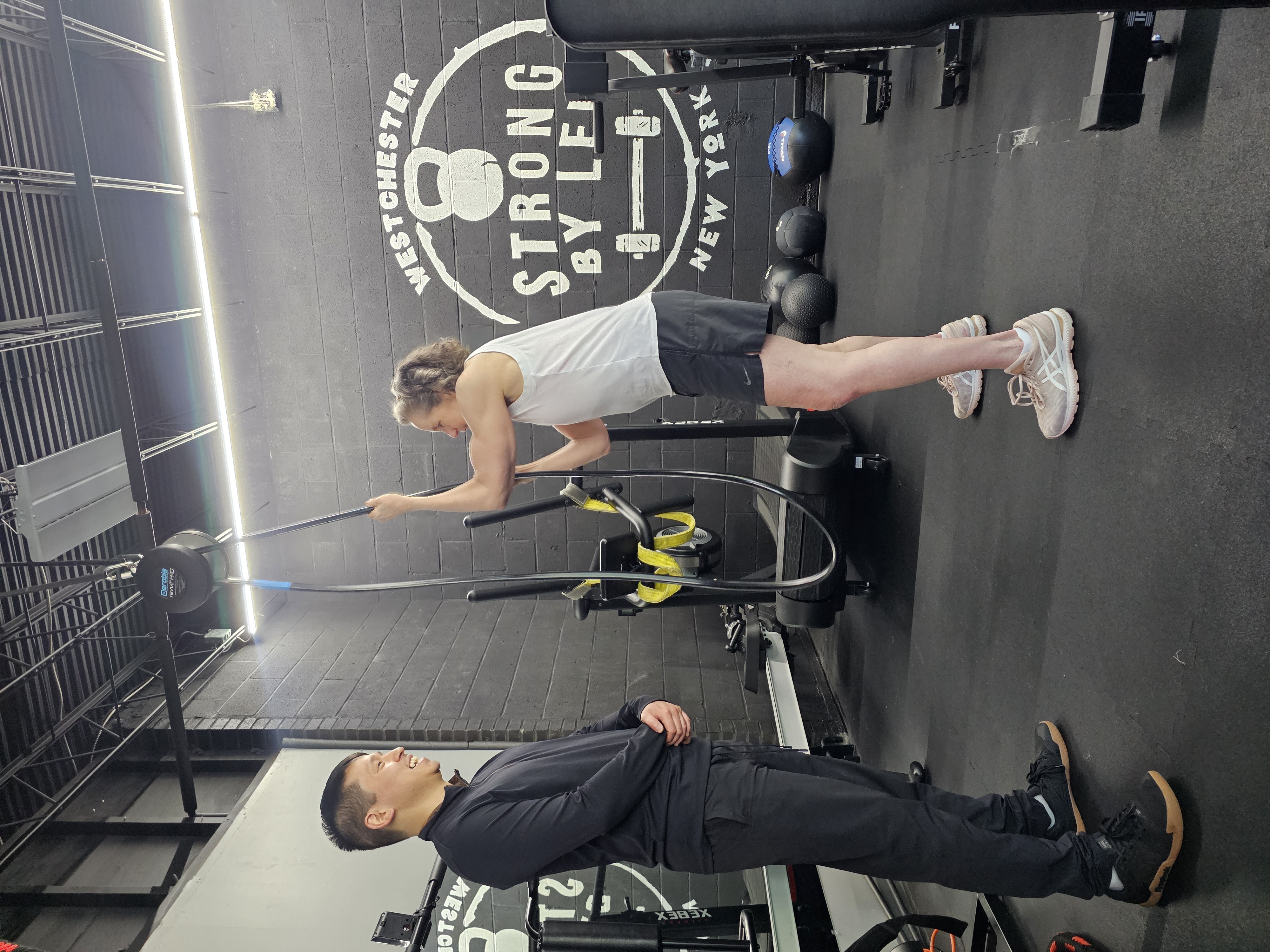
A difficult thing I say to clients is: "I don't know."
Actually, there are more difficult things I say:
"It depends."
"There are many factors."
"We're still trying to figure that out."
We? Who are we? Research, science, and the fitness industry. Health professionals.
Having been in the fitness industry for over 15 years, I have taken notice of the subtle shifts in language fitness professionals engage in. Back in the day, there were more "do this, get that" promises. More confidence — dare I say arrogance — in their approach.
Nowadays, though, I sense more compassion and nuance. Fitness pros are less inclined to make lofty promises so hastily because it may not be true, and because people aren't buying it anymore.
The nuanced approach is the one I now prefer. I realized throughout my career that there are so many different factors that can influence one's results. I thought having a nuanced approach made me more personable, honest, and... "authentic."
But you know what's funny? After going back and forth with Claude (AI), I was told that being nuanced is another form of "not answering the question."
I never thought of it this way. Maybe I am circling around the problem, using "it depends" as an answer? It also shields me from a potentially wrong answer. If I were to say something like...
"I'm not quite sure why you're not seeing the results you expected. It could be your genetics, it could be your heavy workload, it could be your lifestyle schedule. It could be a number of things."
...it would protect me from having a conviction. The idea is that I should know how to fix my clients' problems. After all, they're coming to me so I can fix them, right?
Here's something else that I found funny, though. After going back and forth with Claude, I realized that Claude doesn't always have the right answer, either. I would ask a question; he would give me an answer. I would modify my next question to reflect his answer; he would give me another answer. And thus, the cycle continued for a few rounds.
The exchanges helped me realize that for some of life's biggest questions, there may not be a clean, simple answer or solution. Sometimes, we must be satisfied with a nuanced one.
I've had many clients express frustrations at how "soft" their bellies were, or "flabby" their arms were, or their neck pain. A client I worked with for several years — jacked all over, except for his belly — expressed such frustrations that he couldn't get a flat, hard, defined stomach.
After some questions, we came to a conclusion: genetics. Ah, that dirty G word.
Me: "How long do you feel you've had a soft belly?"
Him: "As long as I could remember."
We still worked hard together; he got stronger, more fit, more conditioned. But his belly always lagged behind his other body parts. I want to think he arrived at acceptance — and based on how long he stayed with me, perhaps he did. Unless my charm was undeniable. But if I had to guess, he was constantly thinking about how to make his belly flatter.
Genetics isn't the answer most people want to hear. It is the truth, however. I see it in front of my eyes every day with my son and daughter. My 9-year-old son already has defined abs while my 8-year-old daughter, while her stomach is flat, is not defined as his. They eat nearly identically, exercise together, play the same sports.
What could possibly explain the variance? Genetics.
When they get older and if they ever ask me why their stomach looks the way it does, my answer will be: "Your stomach has been like that for as long as I can remember."
What does this mean for my coaching?
Shielding myself from having a strong conviction in any one answer allows me to explore other options comfortably. It doesn't keep me emotionally attached to any single approach. Here's something I have commonly said to my clients:
"I'm not 100% on what's causing your problems at the moment, but here are some approaches we can take that I have confidence and experience in."
Despite telling clients I may not know the answer, I can still give them directions. Modifications in their training. More guidance on nutrition. Suggesting bloodwork from their doctor.
Ultimately, a nuanced approach is the strategy that defines my work — and allows me to work with people from nearly all walks of life.
Cheers.
— David